 CN

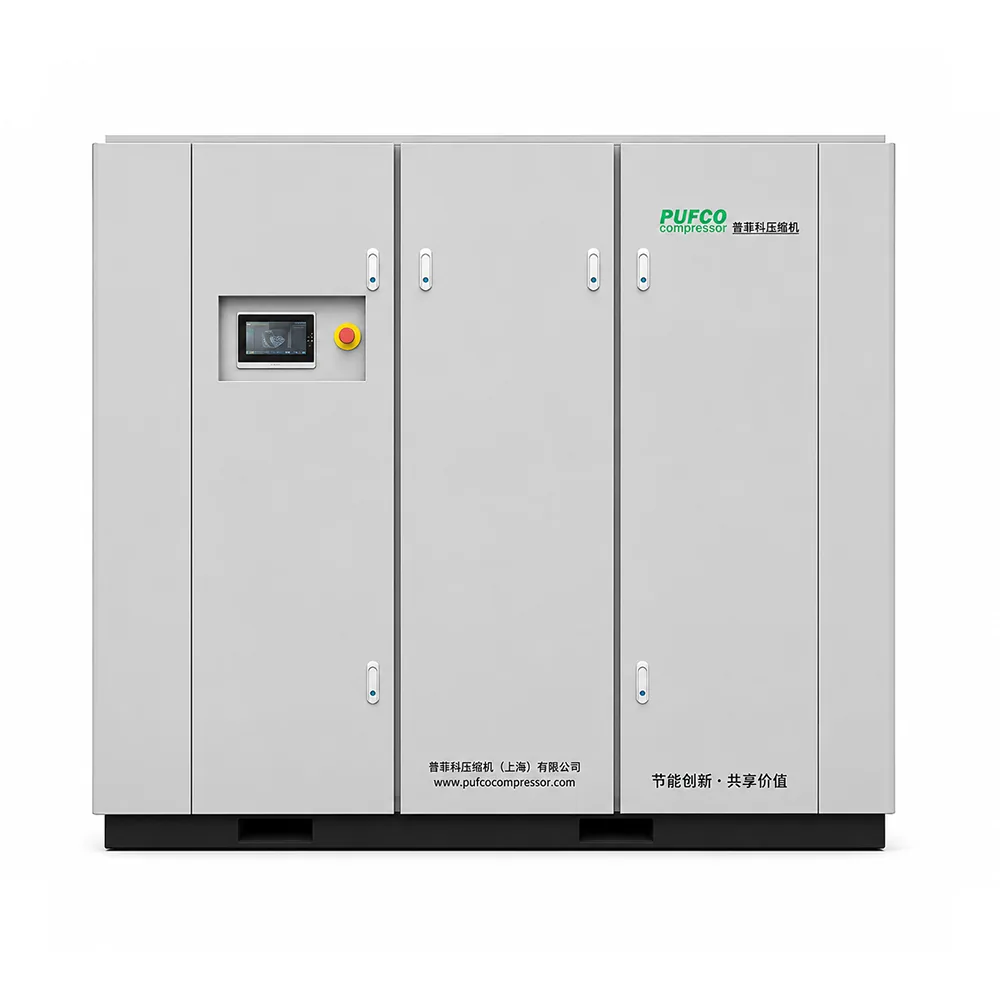
Two-stage permanent magnet variable frequency air compressor
Power:22KW-250KW
Working Pressure:0.75Mpa-1.3Mpa
Air Capacity:3.2³/min-54m³/min
Voltage:380V, 110V, 220V, ets.
- Overview
- Product Advantages
- Technical Parameters
- Application Scenarios
- FAQ
- Two compression stages share the required pressure rise.
- Interstage cooling manages heat before the next stage.
- Permanent-magnet drive adjusts speed as demand changes.
- Match capacity to normal and reduced production demand.
- Coordinate drying and filtration with process air quality.
- Confirm package ventilation and the selected component specification.
Two-Stage Compression with Permanent-Magnet Speed Control
PUFCO two-stage permanent-magnet variable-speed air compressors combine staged pressure rise with demand-responsive motor control. Each compression stage handles part of the overall pressure increase, with cooling before air enters the next stage. Compressor speed adjusts within the permitted operating range as production air consumption changes.
Cooling and Monitoring in One Industrial Package
The package brings together pressure and temperature monitoring, dedicated cooling and corrosion-resistant internal pipework. Its controller makes running conditions available for daily checks. Selection should consider sustained demand alongside lower-consumption periods, then coordinate pressure settings, downstream air treatment and installation ventilation with the proposed compressor.
Core Design
Configuration and Selection
For a quotation, share required airflow, pressure, demand variation and installation conditions.
Why choose our air compressor solutions
Two-Stage Compression
Splitting the pressure rise between two stages limits the compression ratio at each air end. Cooling between stages helps reduce compression work for the required delivery pressure.
Demand-Responsive Motor Control
The permanent-magnet variable-speed drive adjusts compressor speed as demand changes within its operating range. This gives the unit a way to coordinate air output with equipment use and production schedules.
Cooling Between Stages
Interstage cooling removes heat before air enters the next compression stage. It manages heat at the handover between stages and is coordinated with the complete package cooling arrangement.
Corrosion-Resistant Pipework
Stainless-steel pipework addresses corrosion resistance in the internal air connections. This construction choice is part of the complete package, with the pipe routing coordinated around the compressor and its service points.
Operating Condition Monitoring
Pressure and temperature sensors feed the dedicated compressor controller. Operators can check key running conditions from the interface and use that information when managing the unit and planning service.
Dedicated Cooling Arrangement
An independent cooling fan and cooler form part of the package thermal design. This arrangement manages heat removal alongside the compressor, motor and controls, with ventilation matched to the installation.
| Model | Power (KW) | Working Pressure (Mpa) | Displacement (m³/min) | Overall Dimension (mm) | Weight (kg) | Outlet Pipe Diameter | ||
|---|---|---|---|---|---|---|---|---|
| Length (L) | Width (W) | Height (H) | ||||||
| FVA-22Ⅱ | 22KW | 0.75 | 4.3 | 1560 | 1000 | 1160 | 450 | RP1 |
| 0.85 | 4.1 | 1560 | 1000 | 1160 | 450 | RP1 | ||
| 1.05 | 3.5 | 1560 | 1000 | 1160 | 450 | RP1 | ||
| 1.3 | 3.2 | 1560 | 1000 | 1160 | 450 | RP1 | ||
| FVA-30Ⅱ | 30KW | 0.75 | 6.5 | 1750 | 1150 | 1290 | 650 | RP1 1/2 |
| 0.85 | 6.1 | 1750 | 1150 | 1290 | 650 | RP1 1/2 | ||
| 1.05 | 4 | 1750 | 1150 | 1290 | 650 | RP1 1/2 | ||
| 1.3 | 3.7 | 1750 | 1150 | 1290 | 650 | RP1 1/2 | ||
| FVA-37Ⅱ | 37KW | 0.75 | 7.7 | 1750 | 1150 | 1290 | 650 | RP1 1/2 |
| 0.85 | 7.3 | 1750 | 1150 | 1290 | 650 | RP1 1/2 | ||
| 1.05 | 6.1 | 1750 | 1150 | 1290 | 650 | RP1 1/2 | ||
| 1.3 | 5.8 | 1750 | 1150 | 1290 | 650 | RP1 1/2 | ||
A two-stage permanent-magnet variable-speed air compressor can supply central plant air systems where a sustained base load is accompanied by changing production demand. Typical duties include pneumatic equipment in machinery manufacturing and textile production, with output adjusted within the selected unit’s operating range. Match the package to the measured minimum, normal, and peak flow at the required pressure, including the pressure losses of downstream dryers, filters, and pipework.
Frequently Asked Questions
Q1: What is the difference between two-stage compression and variable-speed control?
▼A1: Two-stage compression divides the pressure rise between two stages, while variable-speed control adjusts compressor speed to follow changing air demand. The first describes how air is compressed; the second describes how output is controlled within the unit's operating range. Evaluate both the compression design and the load profile when comparing models.
Q2: How do I compare a two-stage variable-speed compressor with a single-stage model?
▼A2: Compare air delivery and electrical input at the same operating pressure and inlet conditions. Then apply the actual demand profile, because full-load efficiency and part-load behavior both affect the final operating cost.
Q3: Can a compressor deliver its maximum airflow at its maximum pressure?
▼A3: Not necessarily; the usable combination is the air delivery specified for the selected model at the required discharge pressure. Maximum airflow and maximum pressure may describe different operating points. Confirm the pressure and delivery together before comparing models or sizing the system.
Q4: What operating information helps select the right size?
▼A4: Provide normal, minimum, and peak air use, the working pressure at the equipment, and the production schedule. Include piping and treatment losses so the quoted discharge pressure reflects the full system.
Q5: What routine maintenance does a two-stage permanent-magnet variable-speed compressor need?
▼A5: Routine maintenance covers inlet filtration, the lubricant circuit, cooling equipment and checks of operating pressure and temperature. Filters, lubricant and other service parts need attention according to the supplied machine's maintenance schedule and actual operating conditions. Review the service-parts list and planned maintenance stops when comparing ownership costs.
Have more questions about this product? Click the chat icon in the bottom-right corner to contact our team.