 CN

Inlet temperature: ≤80℃ (≤45℃)
- Overview
- Product Advantages
- Technical Parameters
- Application Scenarios
- FAQ
- Air-to-air pre-cooling followed by refrigeration
- Liquid separation with automatic condensate drainage
- Air-cooled heat rejection without cooling-water piping
- Inlet airflow, pressure and temperature
- Required pressure dew point and ambient conditions
- Standard or higher inlet-temperature model selection
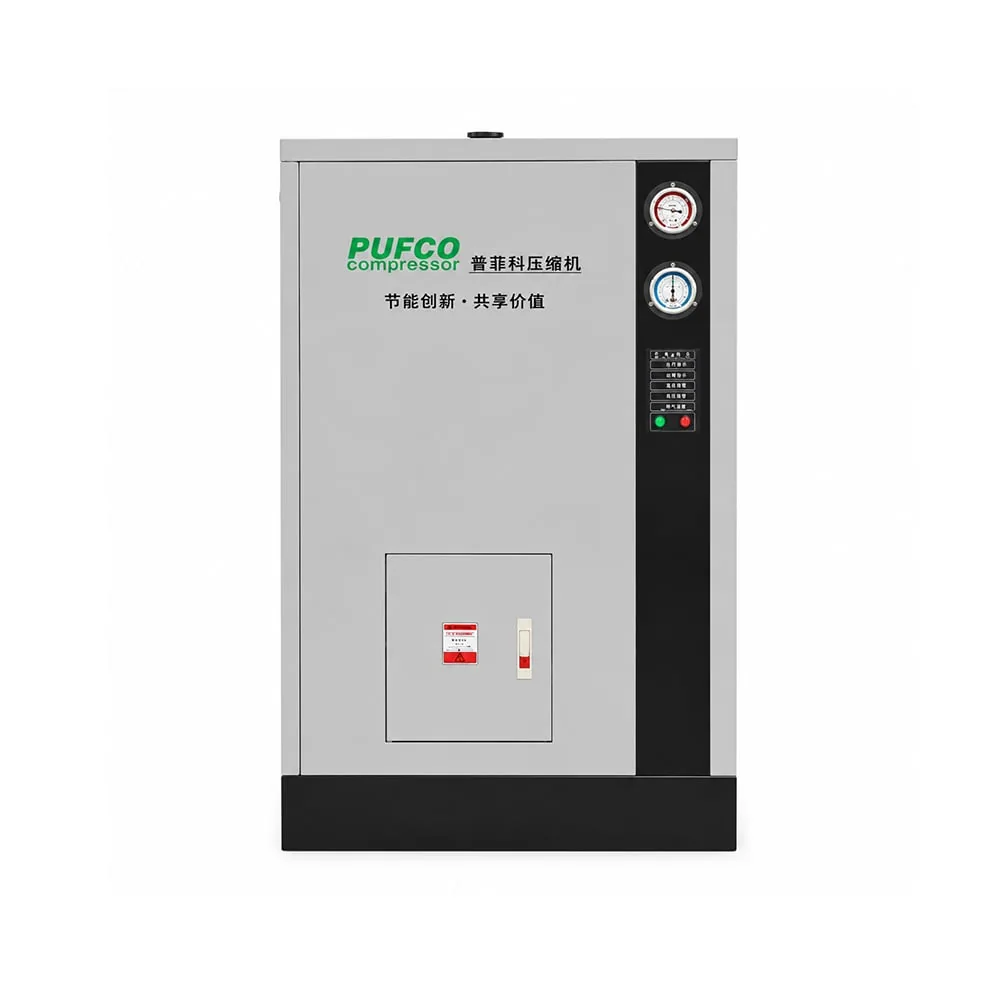
Refrigerated Drying Without Cooling-Water Connections
PUFCO air-cooled refrigerated air dryers remove moisture by cooling compressed air until water vapor condenses into droplets. An air-to-air exchanger pre-cools the incoming stream before refrigeration. Liquid separation and automatic drainage then remove the collected condensate, combining heat exchange and water removal in one drying stage.
Match Heat Rejection to Your Compressor Duty
Air-cooled heat rejection suits installations with adequate ventilation and suitable ambient conditions. Standard and higher inlet-temperature versions provide different selection paths for the compressor discharge conditions. Dryer capacity is matched to actual inlet flow, pressure and temperature, with the required pressure dew point defining the moisture-control target.
Core Design
Configuration and Selection
Send your compressor flow, inlet conditions and moisture target so we can size the dryer for the installation.
Why choose our air compressor solutions
No Cooling-Water Circuit
Air-cooled heat rejection eliminates the need for a dedicated cooling-water connection, simplifying installation utilities where adequate ventilation and suitable ambient conditions are available around the dryer.
Standard And High-Temperature Versions
Separate standard and higher inlet-temperature versions allow the dryer configuration to follow the compressor discharge conditions, rather than treating every installation as the same thermal duty.
Refrigerated Moisture Removal
Refrigeration cools compressed air until water vapor condenses, providing a moisture-removal stage for systems whose required pressure dew point is compatible with the selected refrigerated dryer.
Incoming Air Pre-Cooling
Incoming compressed air exchanges heat with the colder outgoing stream before refrigeration, reducing the temperature entering the evaporator through a coordinated air-to-air heat-exchange arrangement.
Centrifugal Liquid Separation
After refrigeration forms water droplets, centrifugal separation removes the condensed liquid from the air stream, supporting the dryer’s combined cooling and moisture-removal process before discharge.
Automatic Condensate Drainage
An automatic drain discharges separated condensate, reducing the need for routine manual draining while keeping liquid removal as an active part of the compressed-air drying process.
Air Cooling Refrigerated Air Dryer
| Model | Processing capability (Nm3/min) | Intake air temperature | Model | Processing capability (Nm3/min) | Intake air temperature |
| FAD-1CF | 1.5 | ≤50℃ | FAD-1GF | 1.5 | ≤80℃ |
| FAD-2CF | 2.6 | ≤50℃ | FAD-2GF | 2.6 | ≤80℃ |
| FAD-4CF | 4.0 | ≤50℃ | FAD-4GF | 4.0 | ≤80℃ |
| FAD-6CF | 6.5 | ≤50℃ | FAD-6GF | 6.5 | ≤80℃ |
| FAD-15CF | 16.0 | ≤50℃ | FAD-8GF | 8.5 | ≤80℃ |
| FAD-20CF | 21.5 | ≤50℃ | FAD-10GF | 11.0 | ≤80℃ |
| FAD-25CF | 25.0 | ≤50℃ | FAD-13GF | 13.8 | ≤80℃ |
| FAD-28CF | 28.0 | ≤50℃ | FAD-15GF | 17.0 | ≤80℃ |
| FAD-30CF | 30.0 | ≤50℃ | FAD-20GF | 23.0 | ≤80℃ |
| FAD-40CF | 45.0 | ≤50℃ | FAD-25GF | 25.0 | ≤80℃ |
| FAD-50CF | 55.0 | ≤50℃ | FAD-30GF | 30.0 | ≤80℃ |
| FAD-60CF | 65.0 | ≤50℃ | FAD-35GF | 35.0 | ≤80℃ |
| FAD-80CF | 85.0 | ≤50℃ | FAD-40GF | 45.0 | ≤80℃ |
| FAD-100CF | 110.0 | ≤50℃ | FAD-50GF | 55.0 | ≤80℃ |
| FAD-60GF | 65.0 | ≤80℃ | |||
| FAD-80GF | 85.0 | ≤80℃ | |||
| FAD-100GF | 110.0 | ≤80℃ |
An air-cooled refrigerated air dryer is an option for workshop pneumatic tools, automated production equipment and factory air lines where condensed water can disrupt operation. It is suited to installations without a cooling-water circuit, provided room temperature and ventilation allow adequate heat rejection. The required pressure dew point must stay below the lowest downstream pipe temperature; colder or more moisture-sensitive services may require desiccant drying and additional filtration.
Frequently Asked Questions
Q1: How does a refrigerated dryer remove moisture?
▼A1: A refrigerated dryer cools compressed air until some water vapor condenses, then separates and drains the liquid. Remaining moisture is described by the pressure dew point: the temperature at which water begins to condense at the operating pressure. Select the specified dew point for the downstream conditions rather than expecting completely moisture-free air.
Q2: Does the air-cooled dryer need cooling water?
▼A2: The air-cooled arrangement rejects heat to the surrounding air instead of a water loop. It still needs adequate ventilation and acceptable ambient conditions. Confirm the installation clearances and heat load for the selected model.
Q3: Do I need a standard or high-inlet-temperature refrigerated dryer?
▼A3: Choose the configuration rated for the highest temperature expected at the dryer inlet, together with your operating pressure and air flow. Check the model’s rating conditions against those values. If inlet air is too hot for the proposed dryer, an appropriate aftercooling arrangement or a different dryer configuration must be considered.
Q4: Can I use a refrigerated dryer for pipework exposed to freezing temperatures?
▼A4: A refrigerated dryer alone may not provide a low enough pressure dew point for pipework exposed to freezing temperatures. The specified dew point must be below the lowest temperature expected in the downstream system, with an appropriate margin. If a lower dew point is required, evaluate a correctly specified desiccant dryer.
Q5: Does this dryer also provide complete air filtration?
▼A5: No. Drying and filtration address different contaminants. Select particulate and oil-aerosol filtration as required by the process, and assess any oil-vapor treatment separately. Drain reliability and pressure loss should also be included in the complete treatment design.
Have more questions about this product? Click the chat icon in the bottom-right corner to contact our team.