 CN

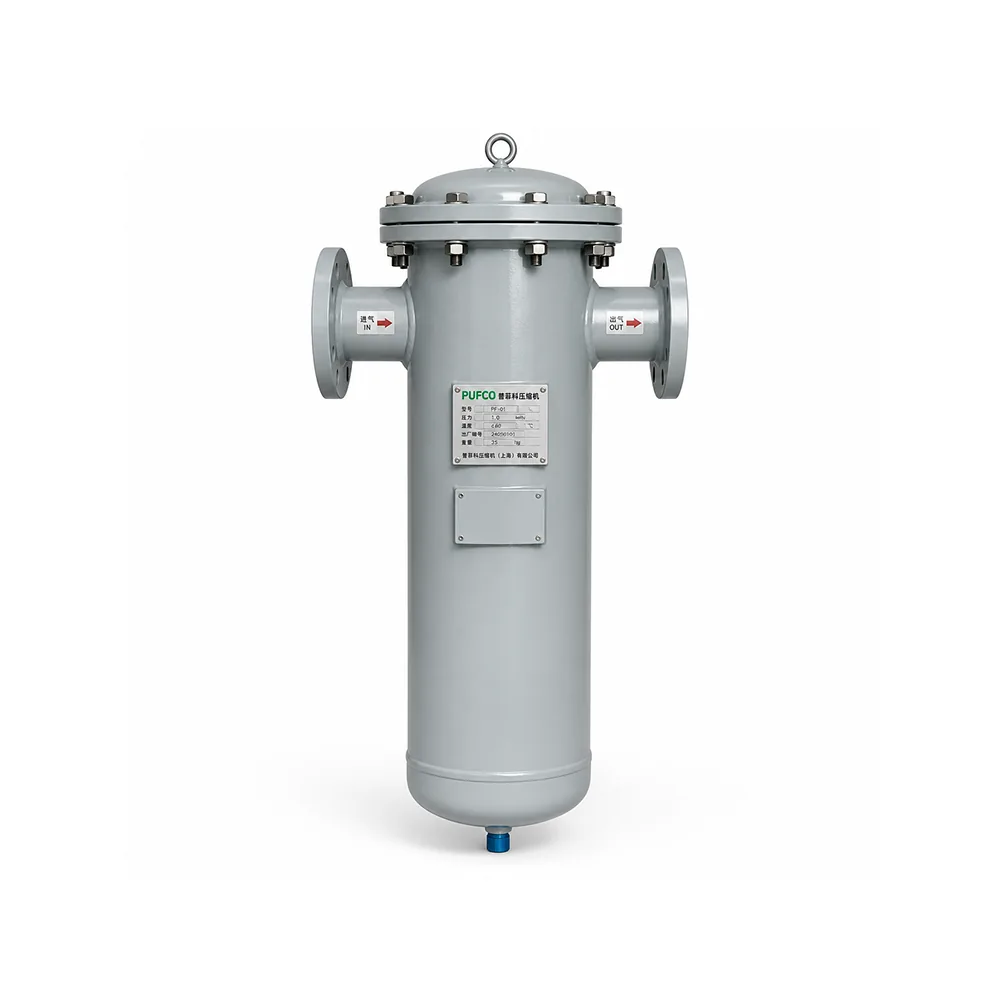
Flange-connection Air Filter
Filter Air Volume: 1.2-55 Nm3/min
Filtration Accuracy: 3.0ppm/1.0ppm/0.01ppm/0.003ppm/0.001μm
- Overview
- Product Advantages
- Technical Parameters
- Application Scenarios
- FAQ
- Flanged connections for compatible larger pipework
- Model-dependent housing sizes and element quantities
- Identifiable element codes for replacement planning
- Airflow, operating pressure and nominal connection size
- Required flange standard and pressure rating
- Target contaminants and confirmed filter-element grade
Flanged Filters for Larger Air-Treatment Lines
PUFCO flange-connection compressed-air filters provide a flanged assembly format for larger pipework. Different nominal connections, body sizes and element quantities support matching the filter to the installation's airflow and layout. Selected bodies contain multiple elements, with the model specification defining the required element arrangement for that housing.
Match the Flange, Housing and Filter Function
Element-grade selection defines which contaminants the filtration stage is intended to control. The flange standard and pressure rating must also suit the connected pipework. Model-specific element codes and quantities support replacement planning, while liquid removal, drainage and drying are coordinated within the wider compressed-air treatment system.
Core Design
Configuration and Selection
Send your airflow, piping specification and air-quality requirements so we can match the complete filter assembly.
Why choose our air compressor solutions
Flanged Pipework Integration
Flanged connections provide a practical assembly format for compatible larger pipework, with connection dimensions and pressure class matched to the piping specification used by the plant.
Model-Specific Multi-Element Layouts
Selected filter bodies use multiple elements to accommodate their rated treatment arrangement, providing different assembly sizes rather than assuming every housing contains the same single element.
Matched Housing And Connection Sizes
Different nominal connections and body models allow the assembly to be matched to the air flow and pipe layout, keeping the filter sizing tied to the complete installation.
Selectable Filter-Element Grades
Several element-grade identifiers allow the filtration function to be matched to the target contamination, with the selected element specification defining the intended role in the treatment line.
Clear Replacement-Element References
Model-specific element codes and quantities help identify the replacement set for each housing, supporting spare-parts planning and scheduled servicing of the compressed-air filter assembly in operation.
Factory And OEM Support
PUFCO manufactures its equipment and accepts OEM and ODM projects. Factory discussions help align the proposed package with installation requirements, while technical support assists with equipment selection and maintenance planning.
| Filter Model | Flow Rate (Nm³/min) | Filtration Rating | Connection (G-thread) | Filter Element Model | Quantity of Filter Elements |
| FI-D/G/H/A/U-015FL | 15 | 3μm 0.01μm 0.003μm 0.001μm | DN65 | 9241401* | 1 |
| FI-D/G/H/A/U-020FL | 20 | DN80 | 9241441* | 1 | |
| FI-D/G/H/A/U-025FL | 25 | DN80 | 9241481* | 1 | |
| FI-D/G/H/A/U-030FL | 30 | DN80 | 9241401* | 2 | |
| FI-D/G/H/A/U-040FL | 40 | DN100 | 9241441* | 2 | |
| FI-D/G/H/A/U-050FL | 50 | DN100 | 9241441* | 3 | |
| FI-D/G/H/A/U-060FL | 60 | DN125 | 9241441* | 3 | |
| FI-D/G/H/A/U-080FL | 80 | DN125 | 9241441* | 4 | |
| FI-D/G/H/A/U-100FL | 100 | DN150 | 9241441* | 5 | |
| FI-D/G/H/A/U-120FL | 120 | DN150 | 9241441* | 6 | |
| FI-D/G/H/A/U-140FL | 140 | DN200 | 9241441* | 7 | |
| FI-D/G/H/A/U-160FL | 160 | DN200 | 9241441* | 8 | |
| FI-D/G/H/A/U-180FL | 180 | DN200 | 9241441* | 8 | |
| FI-D/G/H/A/U-200FL | 200 | DN200 | 9241481* | 9 | |
| FI-D/G/H/A/U-240FL | 240 | DN250 | 9241481* | 12 | |
| FI-D/G/H/A/U-260FL | 260 | DN250 | 9241482* | 13 | |
| FI-D/G/H/A/U-280FL | 280 | DN250 | 9241483* | 14 | |
| FI-D/G/H/A/U-300FL | 300 | DN250 | 9241481* | 15 |
A flange-connected compressed air filter is a candidate for central treatment stations and larger flanged air lines serving multiple production users. It can be installed before or after a dryer when the selected element grade matches the contaminants and equipment requirements. Housing selection must account for design flow, pressure loss and the actual flange standard, with space for isolation, drainage and element replacement. This filtration stage does not replace drying where water vapor must be controlled.
Frequently Asked Questions
Q1: Which flange standard should I specify?
▼A1: Specify the flange standard, nominal size, pressure rating and sealing face that match the connected pipework. DN identifies nominal diameter and does not, by itself, confirm compatibility with an ASME, EN or other flange specification. Check the actual mating dimensions and the proposed housing connection before purchase.
Q2: How should I compare filter pressure drop and its effect on operating cost?
▼A2: Compare the complete filter's pressure drop at the same airflow, operating pressure and filtration grade. Pressure drop is the pressure lost across the filter; if the system compensates by increasing compressor pressure, that can increase energy use. Review both clean-element performance and the specified replacement limit so downstream equipment retains the pressure it needs.
Q3: How should I select the filtration grade?
▼A3: Define the downstream requirement for particles, liquid aerosols or other contaminants. Request the exact element specification and test conditions. Particle size and residual oil concentration are different measures and should not be combined into a single accuracy label.
Q4: Does a flange-connected filter stabilize air pressure?
▼A4: No. A filter removes specified contaminants and introduces a pressure drop as air passes through it. Air storage and pressure regulation require a suitable receiver, regulator and system controls. Select those components for the pressure-stability requirement rather than treating a flange-connected filter housing as a substitute.
Q5: What maintenance access does the installation need?
▼A5: Plan safe isolation, drainage and clearance to remove the fitted elements. Confirm the inspection and replacement procedure for the selected housing. The maintenance arrangement matters particularly where a model contains several elements or serves a central air network.
Have more questions about this product? Click the chat icon in the bottom-right corner to contact our team.