 CN

- Overview
- Product Advantages
- Technical Parameters
- Application Scenarios
- FAQ
- Carbon molecular sieve nitrogen separation
- Alternating adsorption and regeneration towers
- Programmable control of the production sequence
- Required nitrogen purity and usable gas output
- Feed-air preparation and buffer equipment scope
- Monitoring options and any separate pressure boosting
On-Site Nitrogen Through PSA Separation
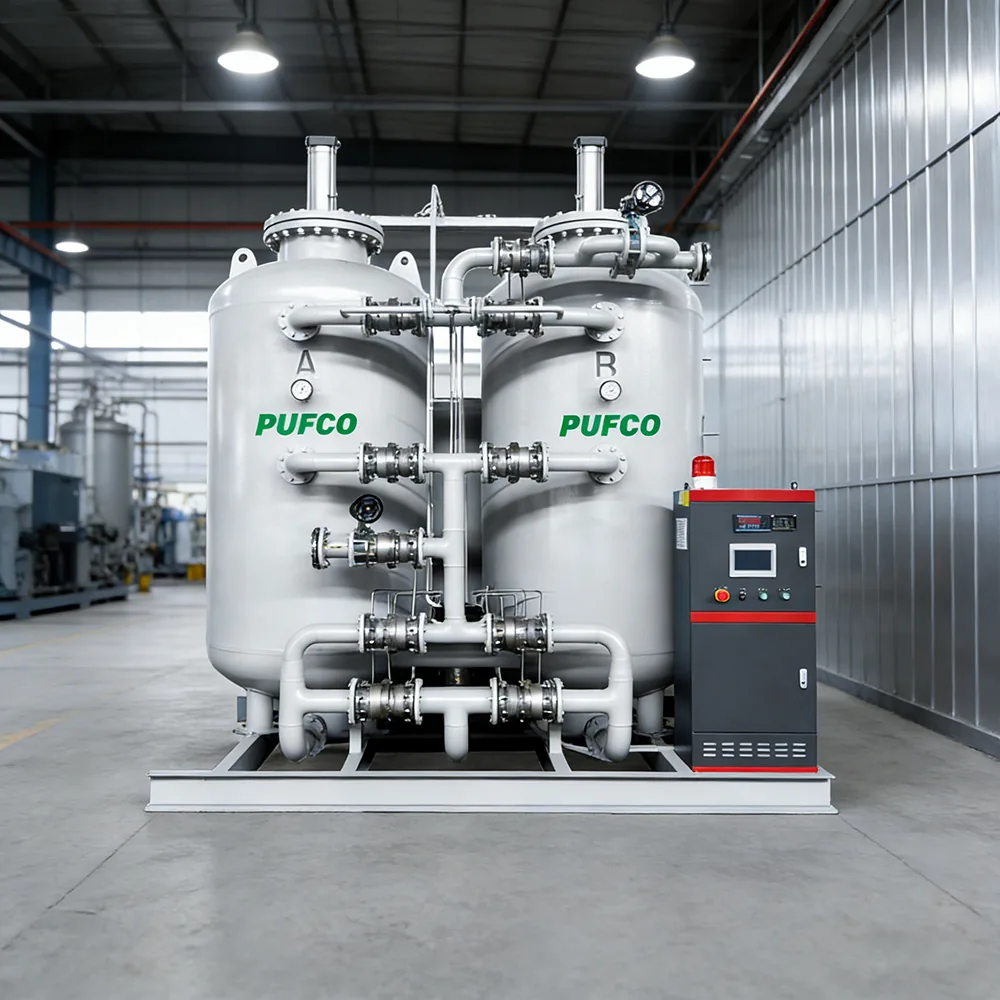
PUFCO PSA nitrogen generators separate nitrogen from prepared compressed air using carbon molecular sieve beds. Two adsorption towers alternate between gas production and regeneration, coordinated by programmable controls. The generator forms part of a complete supply arrangement that includes the air preparation and buffering required by the project.
Specify Nitrogen Quality and Output Together
Nitrogen purity, usable output and feed-air demand are evaluated together when sizing the system. Configured instruments can display gas purity, flow and operating status, while optional remote monitoring supports wider supervision. Higher-pressure storage or process delivery may require a separate booster matched to the generator and receiving equipment.
Core Design
Configuration and Selection
Provide nitrogen purity, consumption and delivery pressure so we can coordinate the generator with your complete supply system.
Why choose our air compressor solutions
On-Site Nitrogen Generation
Carbon molecular sieve separates nitrogen from treated compressed air, creating an on-site production route that can be sized around the plant’s required nitrogen quality and consumption.
Alternating Adsorption Towers
Two adsorption towers alternate between production and depressurization regeneration, allowing one bed to release retained gases while the other continues the nitrogen separation process.
Programmable Process Control
Programmable control coordinates valve switching and operating sequences, reducing the need to manage each adsorption and regeneration step manually during normal nitrogen generator operation.
Visible Gas Production Parameters
Configured instrumentation displays nitrogen purity, flow and equipment status, helping operators follow production conditions and compare the gas supply with the downstream process requirements.
Optional Remote Monitoring
Optional IoT functionality enables remote monitoring and data analysis from a computer or mobile terminal. This gives the team another way to follow generator operation beyond the local control interface.
Coordinated Air And Buffering
The system arrangement coordinates compressed-air preparation, buffer vessels and nitrogen storage, helping align the generator with its upstream air supply and downstream consumption pattern for the selected project.
| NAME | Model | Purities | Air consumption (Nm³/min) | Nitrogen production (Nm³/h) |
| PSA Nitrogen Generator | FAZD95 | 95% | 0.88–116.96 | 30–4000 |
| PSA Nitrogen Generator | FAZD97 | 97% | 0.96–128.65 | 30–4000 |
| PSA Nitrogen Generator | FAZD98 | 98% | 1.1–136.2 | 30–4000 |
| PSA Nitrogen Generator | FAZD29 | 99% | 0.82–122.81 | 20–3000 |
| PSA Nitrogen Generator | FAZD295 | 99.50% | 0.85–105.99 | 20–2500 |
| PSA Nitrogen Generator | FAZD39 | 99.90% | 0.53–94.74 | 10–1800 |
| PSA Nitrogen Generator | FAZD49 | 99.99% | 0.73–87.72 | 10–1200 |
| PSA Nitrogen Generator | FAZD59 | 99.999% | 0.92–73.68 | 10–800 |
| Note: Contact us and we will provide you with detailed parameters as well as an exclusive offer. | ||||
A PSA nitrogen generator can provide on-site nitrogen for protective-gas duties in chemical production and for laser-cutting installations, where the selected gas purity and supply conditions meet the process specification. Air treatment and nitrogen buffering help match generation to routine consumption and demand peaks. If the point of use needs higher pressure, a separately specified nitrogen booster can be integrated, with generator output and storage sized for the complete system.
Frequently Asked Questions
Q1: When is on-site nitrogen generation worth considering instead of cylinder or liquid nitrogen supply?
▼A1: Consider on-site generation when regular nitrogen demand makes the cost and logistics of cylinder or liquid supply significant. Compare equipment, compressed-air electricity, treatment, maintenance and any required boosting with the total cost of your existing supply at the same purity, pressure and usable flow. Savings and payback depend on that comparison rather than generator capacity alone.
Q2: Why must purity and nitrogen flow be selected together?
▼A2: Production capacity and compressed-air consumption vary with the required nitrogen purity. Specify the process purity and flow together so generator capacity and compressed air supply can be sized for the same operating duty.
Q3: What equipment is needed before a PSA nitrogen generator?
▼A3: Provide a suitable air compressor, buffer storage and compressed-air treatment before the nitrogen generator. The feed-air pressure, flow, moisture and oil limits must meet the selected generator's requirements. Confirm the required treatment equipment and whether it is included in the quoted package.
Q4: Is a nitrogen booster always included with the generator?
▼A4: A nitrogen booster is included only if it is listed in the agreed package scope. Additional compression is needed when the required delivery pressure exceeds the generator's outlet pressure. Confirm source compatibility, buffer storage, compressor sizing and the receiving system when specifying a boosted nitrogen supply.
Q5: Can the nitrogen system be monitored from a plant control system?
▼A5: Plant-system integration can be specified when the required communication interface is included in the selected control package. Define the signals, protocol and connection to your plant's distributed control system (DCS). Remote monitoring and plant communications should be agreed explicitly rather than assumed to be standard.
Have more questions about this product? Click the chat icon in the bottom-right corner to contact our team.