In the industrial sector, air compressors are essential equipment, and their energy consumption accounts for a significant proportion of the total industrial electricity usage. For business owners and plant managers, reducing energy costs while ensuring stable air supply is always a top priority. One question that is frequently asked is: Are permanent magnet variable frequency (PM VFD) screw air compressors really energy-saving? The short answer is yes—they are not only energy-saving but also far more efficient than traditional fixed-speed or ordinary variable frequency screw air compressors, with energy savings ranging from 20% to 50% in different working conditions. In this article, we will explore the energy-saving principles, specific advantages, and practical data of PM VFD screw air compressors to help you understand why they are a cost-effective choice for modern industries.
What Is a Permanent Magnet Variable Frequency Screw Air Compressor?
Before delving into its energy-saving performance, it is necessary to clarify what a PM VFD screw air compressor is. It is an advanced air compression system that combines a high-efficiency permanent magnet synchronous motor (PMSM) with a variable frequency drive (VFD) to power a rotary screw air end. Unlike traditional fixed-speed air compressors that run at a constant speed regardless of air demand, PM VFD models integrate intelligent speed regulation technology, which can dynamically adjust the motor speed according to the actual air consumption of the equipment, achieving "on-demand air supply" and minimizing energy waste.
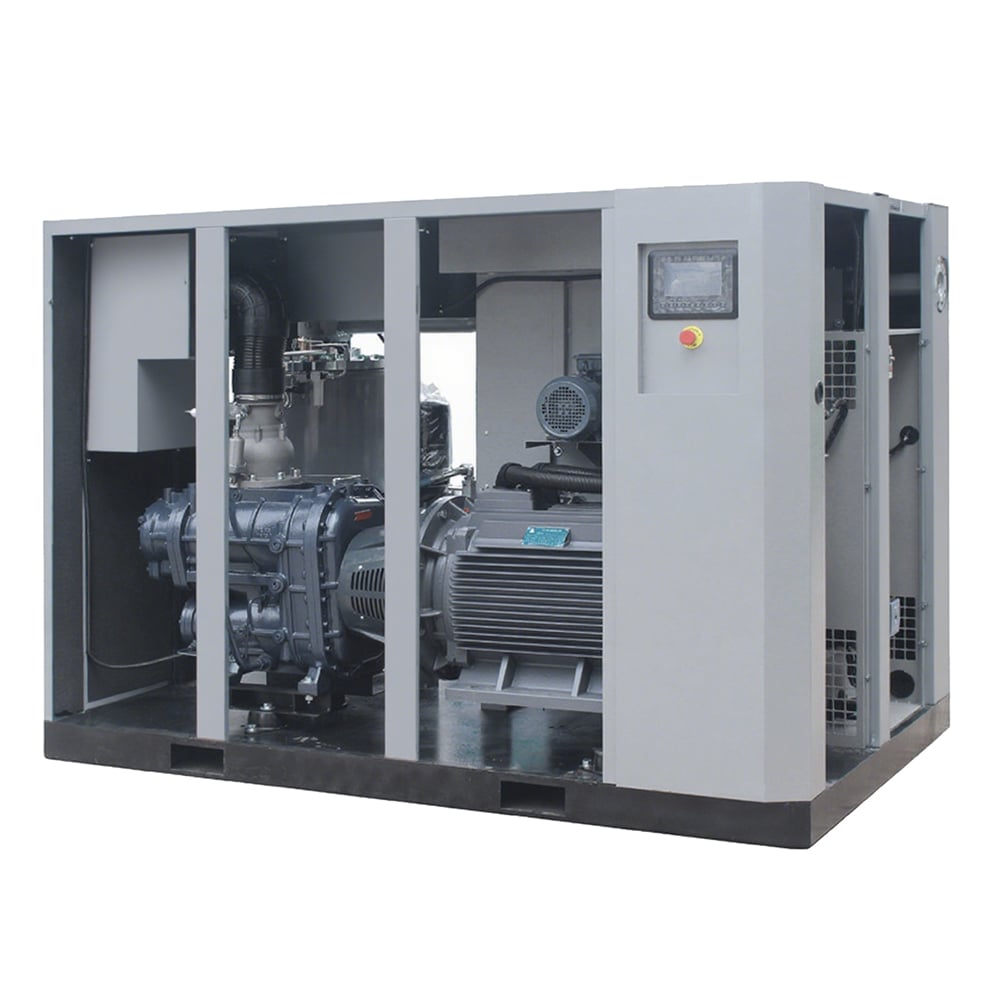
The core components of a PM VFD screw air compressor include the rotary screw air end (with two intermeshing helical rotors), permanent magnet synchronous motor, variable frequency drive, control system with sensors, and cooling and filtration systems. These components work together to ensure efficient, stable, and energy-saving operation of the equipment.
Why Are PM VFD Screw Air Compressors Energy-Saving? Core Principles
The energy-saving advantage of PM VFD screw air compressors stems from the dual advantages of permanent magnet motor technology and variable frequency speed regulation technology. Unlike traditional air compressors that have inherent energy loss, PM VFD models fundamentally solve the problem of energy waste through technological innovation.
1. High Efficiency of Permanent Magnet Synchronous Motor (PMSM)
Traditional fixed-speed or ordinary variable frequency air compressors usually use asynchronous motors, which have obvious energy loss during operation—especially rotor copper loss, which accounts for about 15% of the total loss. In contrast, the permanent magnet synchronous motor uses rare earth permanent magnets for excitation, eliminating the need for an external excitation system and thus completely eliminating rotor copper loss.
At rated speed, the efficiency of a permanent magnet motor is 5% to 8% higher than that of an asynchronous motor (IE5 level vs. IE3 level). For example, a 110kW PM motor can reduce energy consumption by 5.5 to 8.8kW per hour compared to an asynchronous motor of the same power. More importantly, when the motor speed decreases (i.e., under low load conditions), the efficiency of the permanent magnet motor remains above 90%, while the efficiency of the asynchronous motor drops sharply to 82% or even lower at 30Hz (50% of the rated speed). This advantage is particularly critical for industrial scenarios where air demand fluctuates greatly.
Additionally, permanent magnet motors have the characteristics of high power density, small size, and constant torque across speeds. The high-quality bonded NdFeB magnets used in the rotor can retain their magnetic strength up to 120°C and have a service life of more than 15 years, ensuring long-term efficient operation.
2. Precise Adaptation of Variable Frequency Speed Regulation (VFD)
The variable frequency drive (VFD) is the "brain" of the PM VFD screw air compressor. It adjusts the motor speed in real time by changing the electrical frequency, so that the air output of the compressor is perfectly matched with the actual air demand. This is very different from traditional fixed-speed air compressors, which can only run at full speed and adjust the air volume through loading/unloading switching—even when unloading, they still consume 30% to 45% of the rated power to maintain the idle operation of the main unit.
For example, when the downstream air demand drops, the VFD slows down the motor speed, reducing the compressor output and avoiding air waste through blow-off valves; when the demand increases, the VFD speeds up the motor to meet the air supply requirements. This dynamic adjustment means that the unit mostly operates under partial load with minimal extra energy consumption. Moreover, the PM VFD screw air compressor can achieve stepless speed regulation in the range of 0% to 100%, while ordinary variable frequency air compressors can only adjust in the range of 60% to 100%, further expanding the energy-saving space.
3. Reduced Energy Loss from Pressure Band Control
Traditional fixed-speed air compressors need to set a minimum pressure band of 1 Barg to avoid frequent start-up impacts on the unit and power grid. When multiple machines are used together, the pressure band becomes wider, resulting in unnecessary energy loss due to excessive pressure settings. In contrast, the PM VFD screw air compressor can start and stop infinitely without setting a pressure band—only a single pressure point needs to be set. For every 0.14 Barg reduction in the pressure band, the system can save 1% of energy.
4. Energy-Saving Soft Start
The start-up current of traditional air compressors is 3 to 6 times the rated working current, and frequent start-up will waste a lot of electricity. The PM VFD screw air compressor adopts a soft start function, which limits the maximum start-up current to no more than the rated working current, completely avoiding energy waste caused by high start-up current. At the same time, soft start also greatly reduces the impact on power grid equipment and mechanical components, extending the service life of the equipment.
Practical Energy-Saving Data: How Much Electricity Can You Save?
The energy-saving effect of PM VFD screw air compressors is not just a theoretical advantage—it has been verified by a large number of practical cases and data. Let’s take a 37KW (6 cubic meters) air compressor as an example to compare the energy consumption with a traditional belt-driven screw air compressor (working 8 hours a day, 300 days a year, with 5 hours of load operation and 3 hours of no-load operation, and 1 yuan per kWh of electricity):
Machine Type (37KW) |
Energy Consumption During Load (5 hours/day) |
Energy Consumption During No-Load (3 hours/day) |
Annual Total Energy Cost |
Belt-Driven Screw Air Compressor |
35KW × 5h × 1yuan = 175 yuan |
18KW × 3h × 1yuan = 54 yuan |
300 days × (175+54) = 68,700 yuan |
PM VFD Screw Air Compressor |
32KW × 5h × 1yuan = 160 yuan |
3KW × 3h × 1yuan = 9 yuan |
300 days × (160+9) = 50,700 yuan |
Energy-Saving Effect |
15 yuan saved per day |
45 yuan saved per day |
18,000 yuan saved per year |
According to industry data, PM VFD screw air compressors can save 22% to 40% of energy compared to fixed-speed screw air compressors, and 5% to 15% compared to ordinary variable frequency air compressors. In scenarios with large fluctuations in air demand, the energy-saving effect can even reach more than 50%. For enterprises with high air consumption, such as those in mining, chemical, manufacturing, and textile industries, the annual energy cost savings can be tens of thousands or even hundreds of thousands of yuan, which can quickly recover the initial investment difference (usually 1 year) and the total investment cost (2 to 3 years).
Other Advantages of PM VFD Screw Air Compressors
In addition to significant energy savings, PM VFD screw air compressors also have many other advantages that further enhance their cost-effectiveness:
Stable Air Pressure: The frequency conversion control can achieve a pressure fluctuation range of ±0.1bar, ensuring the stable operation of terminal equipment such as pneumatic tools and packaging machinery, and avoiding process defects caused by pressure fluctuations.
Low Noise: The reduced motor speed significantly lowers the operating noise of the air compressor, creating a quieter working environment for the workshop.
Longer Service Life: The gradual start-up acceleration method reduces the impact on electrical and mechanical components during start-up, and the low-speed operation reduces wear of key parts such as bearings and seals, extending the service life of the equipment by more than 50%.
Easy Maintenance: The split direct drive system adopted by many PM VFD models is more reliable and easier to maintain than the integrated drive system, reducing maintenance costs and downtime.
Conclusion: Are PM VFD Screw Air Compressors Worth Investing In?
For enterprises pursuing energy conservation, cost reduction, and efficient operation, the answer is undoubtedly yes. The permanent magnet variable frequency screw air compressor achieves precise matching of air supply and demand through the combination of permanent magnet motor and variable frequency speed regulation technology, fundamentally eliminating energy waste in traditional air compressors. Its energy-saving effect is verified by practical data, and it also brings additional benefits such as stable air pressure, low noise, and long service life.
In the context of global energy conservation and emission reduction, choosing a PM VFD screw air compressor is not only a wise choice to reduce enterprise operating costs but also a positive response to green manufacturing. Whether you are building a new factory or upgrading existing equipment, the PM VFD screw air compressor can bring long-term economic and environmental benefits. To learn more about high-quality PM VFD screw air compressors and get a customized energy-saving solution, visit our official website:
www.pufcocompressor.com.
 Hot News

 CN
CN