 CN
CN
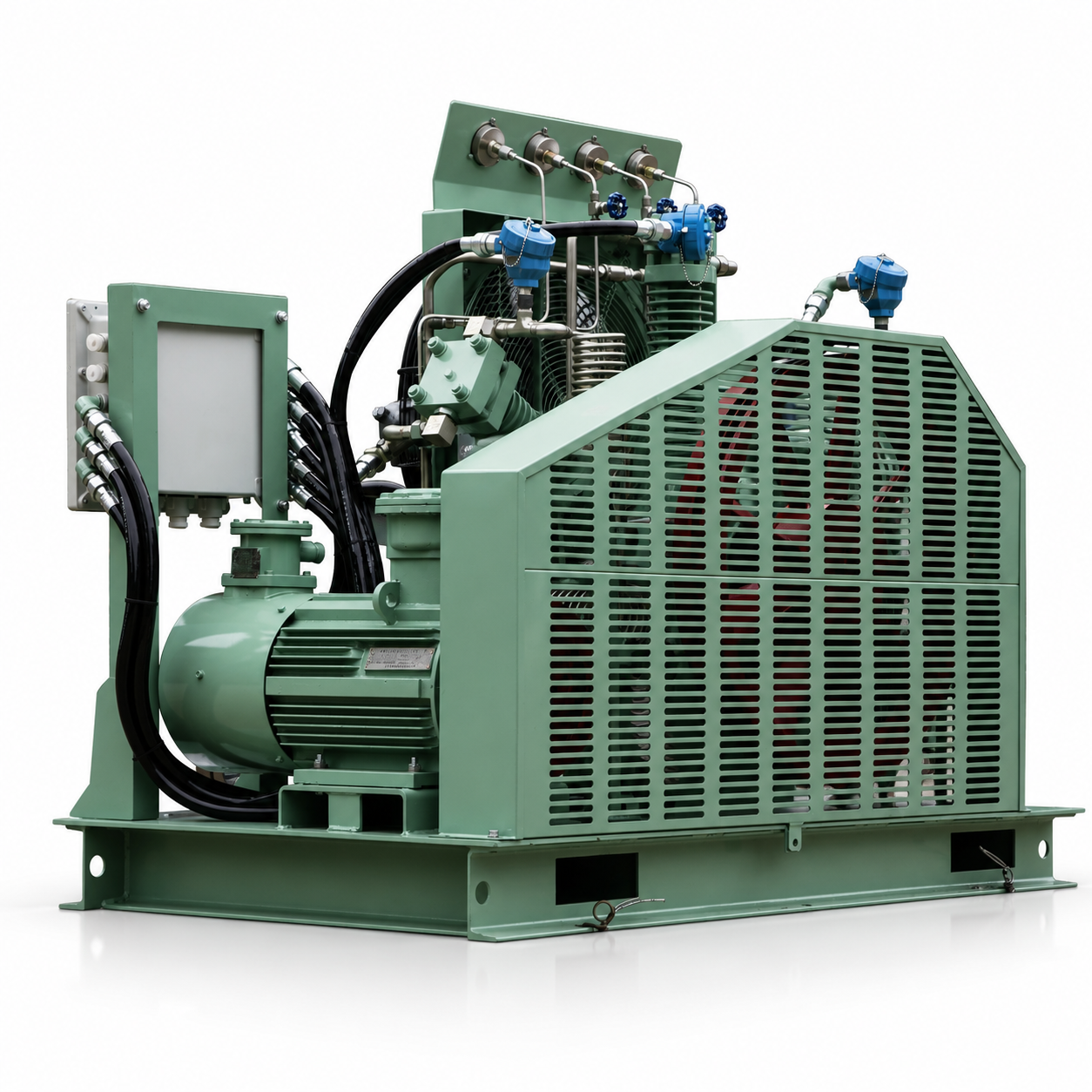
Flammable and Reactive Gases: Hydrogen, Acetylene, and Syngas in Gas Compressor Systems
Hydrogen Embrittlement and Sealing Challenges for Safe Gas Compressor Operation
Hydrogen’s small molecular size and high diffusivity create unique integrity risks in gas compressors. At elevated pressures, atomic hydrogen permeates steel casings and rotor alloys, causing hydrogen embrittlement—reducing ductility and increasing the risk of sudden brittle fracture. To mitigate this, manufacturers specify austenitic stainless steels or nickel-based alloys with stable austenitic microstructures that resist hydrogen trapping at grain boundaries.
Sealing presents an equally demanding challenge: hydrogen’s low viscosity demands micron-level clearance control. Advanced dry-gas seals—featuring spiral-groove faces and diamond-like carbon coatings—are standard for minimizing leakage, yet even sub-micron surface imperfections can compromise performance. Seal gas supply pressure and temperature must be continuously monitored; some operators integrate on-line gas chromatographs to detect early hydrogen breakthrough. Dynamic seal design also accounts for thermal expansion during startup and shutdown cycles.
A 2022 study by a leading research institute found improper material selection reduced component life by 40%. Consequently, safe hydrogen-service compressors integrate metallurgical analysis, precision seal gas conditioning, and real-time monitoring—not as optional enhancements, but as foundational safety requirements.
Acetylene’s Thermal Instability: Why Dissolved-in-Acetone Compression Is Critical for Gas Compressor Safety
Acetylene (C₂H₂) is thermodynamically unstable and prone to exothermic decomposition above 15 psig (1 bar), especially in the presence of heat, shock, or contaminants. Direct compression of gaseous acetylene is therefore prohibited. Instead, industry practice requires dissolving acetylene in acetone within a porous mass inside cylinders—a method that suppresses explosive decomposition by stabilizing molecular energy states.
Gas compressors handling acetylene draw vapor from this acetone solution via the suction line—not from pure gas. Internal temperatures must remain below 100°C to prevent solvent breakdown. Specialized oil-free reciprocating compressors with Teflon-coated cylinders and non-sparking bronze components are used exclusively. Integrated thermal monitoring detects hot spots before they escalate.
Industry safety data from 2021 shows dissolved-in-acetone compression reduces decomposition incidents by over 90%. Operators must maintain proper acetone levels and purge the system with inert gas before maintenance. This approach reflects a fundamental principle: acetylene compression isn’t merely a mechanical process—it’s a thermodynamic containment strategy requiring design alignment with the gas’s inherent instability.
Corrosive and Toxic Gases: Material and Seal Integrity in Sour Gas, Ammonia, and Chlorine Gas Compressors
Handling corrosive and toxic gases in gas compressor systems demands uncompromising material and seal integrity. Sour gas, ammonia, and chlorine environments introduce unique failure mechanisms—from sulfide stress cracking to chemical attack on elastomers—that require specialized design and material selection to prevent catastrophic leaks and unplanned downtime.
NACE-Compliant Materials for H₂S/CO₂-Rich Sour Gas Compressors
Sour gas compressors operate in environments rich in hydrogen sulfide (H₂S) and carbon dioxide (CO₂), which synergistically accelerate corrosion and hydrogen embrittlement. H₂S induces sulfide stress cracking in high-strength steels, while CO₂ forms carbonic acid in moisture-laden systems, driving wall thinning. Compliance with NACE MR0175/ISO 15156 is mandatory for all pressure-containing parts, wetted components, and seal faces.
Preferred materials include austenitic stainless steels, duplex and super duplex alloys, and nickel-based alloys such as Inconel 625—selected for hardness, resistance to environmental cracking, and long-term stability under sour service conditions. A 2023 industry survey attributed 40% of sour gas compressor failures to improper material selection, reinforcing the need for rigorous qualification—not just specification—of every wetted component.
In critical sealing zones, silicon carbide seal faces paired with chemically resistant secondary seals (e.g., perfluoroelastomers) eliminate leakage paths even when trace H₂S is present. This combination extends maintenance intervals and protects personnel without compromising operational reliability.
Ammonia Compatibility: Lubricant Selection and Dry-Gas Seal Optimization for Gas Compressors
Ammonia’s toxicity and reactivity impose strict compatibility requirements across lubricants, bearings, and seals. It aggressively attacks copper and copper alloys, so all lubricant additives—and bearing cage and bushing materials—must be copper-free. Polyalkylene glycol (PAG) and polyalphaolefin (PAO) synthetic lubricants are preferred: they resist ammonia dilution, retain film strength under high loads, and avoid hydrolysis-related degradation.
In dry-gas seal applications, ammonia’s low viscosity and high permeation rate demand tailored groove geometries and robust barrier gas systems to prevent migration into seal faces. A 2022 failure analysis linked 25% of ammonia compressor seal failures to incompatible lubricants or insufficient dry-gas seal venting.
To achieve near-zero emissions and extended seal life, leading manufacturers deploy tandem dry-gas seals using nitrogen or clean process gas as an intermediate buffer—paired with continuous monitoring of seal gas consumption and leakage rates. This integrated approach ensures compliance with stringent environmental and occupational safety standards while sustaining reliable operation.
Cryogenic and Inert Gases: LNG, Helium, and Nitrogen Handling in Low-Temperature Gas Compressors
Cryogenic gas compressors must handle fluids at temperatures ranging from –160°C (LNG) to –269°C (helium), where conventional materials contract severely and standard lubricants solidify. Safe, efficient operation requires purpose-built thermodynamic and sealing strategies aligned with each fluid’s physical behavior.
Thermodynamic Demands of LNG Re-liquefaction and Dual-Stage Gas Compressor Design
LNG re-liquefaction systems—on floating storage units or peak-shaving plants—require compressors capable of raising boil-off gas pressure from ~1 bar to 4–6 bar while managing extreme cold-side heat rejection. Because methane has a low specific heat ratio (γ ≈ 1.3), single-stage compression would elevate discharge temperatures beyond safe limits—potentially exceeding hydrocarbon auto-ignition points and risking thermal runaway.
Dual-stage compression with intercooling resolves this: it lowers the pressure ratio per stage, reduces temperature rise, and improves volumetric efficiency by minimizing internal leakage and re-expansion losses. Industry data from 2023 shows dual-stage designs cut power consumption by up to 15% versus single-stage alternatives. Internals and housings use cryogenically rated materials—such as 9% nickel steel or austenitic stainless steels—to prevent low-temperature embrittlement. The result is not just improved efficiency, but inherently safer thermodynamic control.
Helium’s Leakage Propensity: Shaft Seal and Clearance Strategies for High-Efficiency Gas Compressors
Helium’s atomic size and low viscosity make it the most leakage-prone industrial gas. In helium liquefaction plants, compressors operate at pressures up to 20 bar and temperatures near 80 K—conditions where conventional seals fail rapidly. Maintaining high isentropic efficiency (85%) requires precision engineering at every interface.
Shaft sealing relies on segmented labyrinth seals with radial clearances often below 0.1 mm, combined with dry-gas seals featuring helium-optimized groove patterns. Impeller-to-housing clearances are similarly minimized: a gap of just 0.5 mm can cause 2–3% efficiency loss. Magnetic bearings eliminate oil contamination and enable active rotor positioning—ensuring consistent, repeatable clearances across operating cycles.
Leakage is tightly controlled: typical helium compressors allow less than 0.5% of total flow as seal leakage. Continuous monitoring of seal gas consumption provides early warning of degradation. These measures reflect a broader principle: helium compression success hinges not on brute-force containment, but on nanoscale precision and proactive thermal-mechanical management.
Ultra-High-Purity Semiconductor Gases: SF₆, WF₆, and SiF₄ Compression Protocols for Contamination Control
Metal Fluoride Reactivity and Particle-Free Compression Pathways in Semiconductor Gas Compressors
Compressing ultra-high-purity semiconductor gases—SF₆, WF₆, and SiF₄—requires more than mechanical reliability; it demands absolute particle and chemical purity. These metal fluorides react violently with moisture, oxygen, and common metals, and even trace contamination can destroy nanoscale device structures. A leading manufacturer’s failure analysis confirmed that a single microscopic particle shed from a compressor surface can cause patterning defects on 3nm wafers—directly impacting yield and profitability.
Accordingly, the compressor functions as a precision fluid-handling instrument—not a utility device. Contact surfaces are electropolished 316L stainless steel or advanced nickel alloys selected for fluoride resistance and minimal ion leaching. For WF₆, which aggressively corrodes most metals, non-metallic dynamic seals and static O-rings made from perfluoroelastomer compounds provide chemical inertness without wear debris.
Lubrication is eliminated entirely: dry-running, non-lubricated architectures prevent vaporized oil from contaminating the gas stream. Integrated point-of-use purifiers and helium leak-tight construction ensure inlet and outlet purity remain identical—delivering gas ready for wafer metallization or etching without downstream filtration. This level of control reflects the convergence of materials science, ultra-clean manufacturing, and gas dynamics—where compressor design is inseparable from process yield.
FAQ
What is hydrogen embrittlement, and how is it managed in gas compressors?
Hydrogen embrittlement occurs when atomic hydrogen penetrates steel alloys, reducing ductility and increasing the risk of brittle fractures. It is managed by using austenitic stainless steels or nickel-based alloys with stable microstructures, as well as advanced sealing technologies like dry-gas seals with micron-level precision.
Why is acetylene dissolved in acetone for safe compression?
Acetylene is thermodynamically unstable and can decompose explosively. Dissolving it in acetone stabilizes its molecular energy states and prevents decomposition during compression.
What materials are suitable for sour gas compressors?
Suitable materials for sour gas compressors include austenitic stainless steels, duplex alloys, and nickel-based alloys such as Inconel 625. These materials comply with NACE MR0175/ISO 15156 standards for resistance against sulfide stress cracking and chemical corrosion.
How are cryogenic gases like LNG and helium handled in gas compressors?
Low-temperature gases like LNG and helium are handled using dual-stage gas compressors with cryogenically rated materials to prevent thermal embrittlement. Specialized seals and magnetic bearings ensure minimal gas leakage and high efficiency.
What measures are adopted for ultra-high-purity semiconductor gas compression?
Particle-free compression pathways, electropolished 316L stainless steel surfaces, and non-lubricated architectures are used. These measures ensure chemical and particle purity, meeting the highly stringent requirements of semiconductor manufacturing processes.
Table of Contents
- Flammable and Reactive Gases: Hydrogen, Acetylene, and Syngas in Gas Compressor Systems
- Corrosive and Toxic Gases: Material and Seal Integrity in Sour Gas, Ammonia, and Chlorine Gas Compressors
- Cryogenic and Inert Gases: LNG, Helium, and Nitrogen Handling in Low-Temperature Gas Compressors
- Ultra-High-Purity Semiconductor Gases: SF₆, WF₆, and SiF₄ Compression Protocols for Contamination Control
-
FAQ
- What is hydrogen embrittlement, and how is it managed in gas compressors?
- Why is acetylene dissolved in acetone for safe compression?
- What materials are suitable for sour gas compressors?
- How are cryogenic gases like LNG and helium handled in gas compressors?
- What measures are adopted for ultra-high-purity semiconductor gas compression?

