 CN
CN
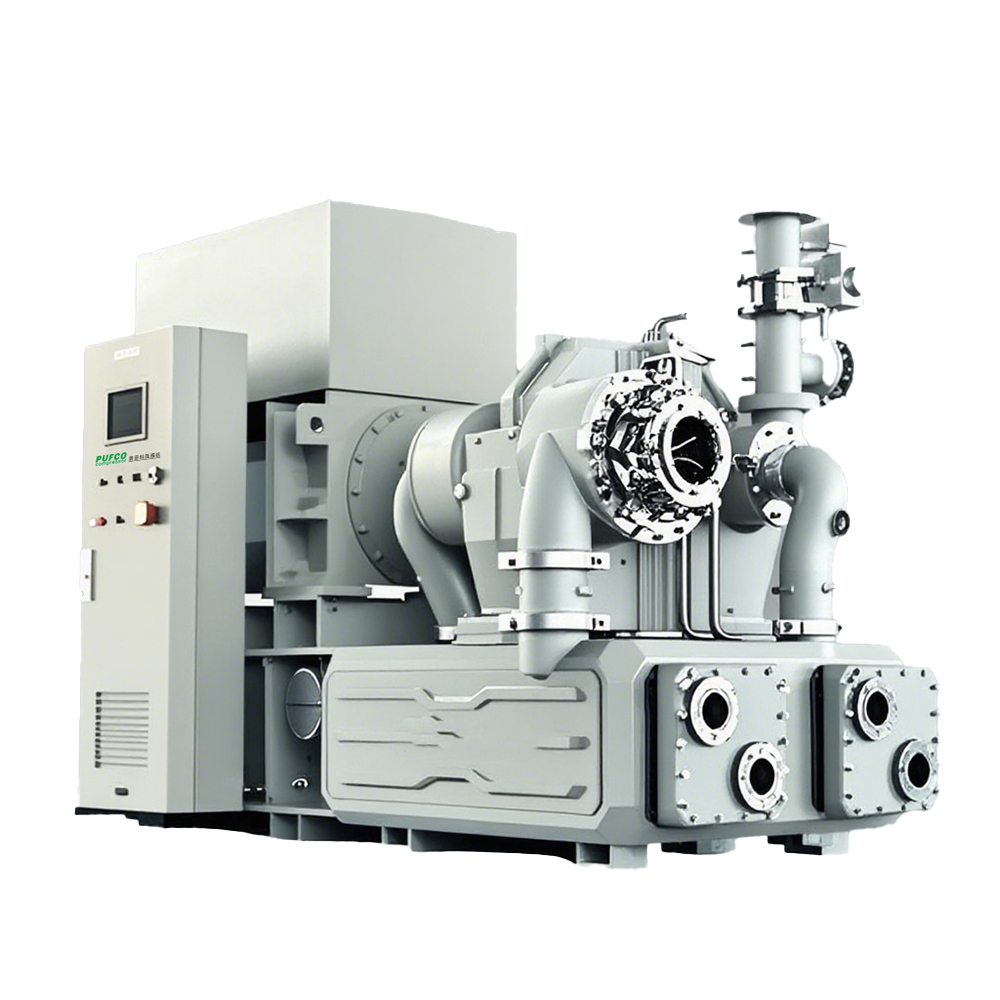
Centrifugal Air Compressor Working Principles: Kinetic-to-Pressure Energy Conversion
Impeller acceleration and diffuser deceleration: The core physics of continuous pressure rise
A centrifugal air compressor converts kinetic energy into static pressure through two synchronized stages. First, a high-speed rotating impeller draws ambient air axially into its eye and accelerates it radially outward via centrifugal force—imparting significant kinetic energy. Next, the high-velocity air enters a stationary diffuser, where the gradually expanding cross-sectional area causes controlled deceleration. Per Bernoulli’s principle, this reduction in velocity converts kinetic energy into usable static pressure. Unlike positive-displacement compressors, this process is fully continuous and mechanically uninterrupted, delivering smooth, pulsation-free airflow. The design mirrors principles used in jet engines and centrifugal fans—but is optimized for industrial compressed air generation. With only the impeller in direct contact with the airstream, oil-free operation is achievable using dry gas seals, supporting critical applications where contamination is unacceptable. This architecture enables large-volume, stable-pressure output ideal for base-load industrial operations.
Multi-stage design and energy staging: Enhancing stability and turndown capability
Most industrial centrifugal air compressors employ multiple impeller–diffuser stages arranged in series to achieve higher discharge pressures while preserving efficiency and operational stability. Each stage contributes incrementally to the overall compression ratio—typically 1.5:1 to 2.5:1 per stage—reducing mechanical stress and thermal loading on individual components. Interstage cooling further improves efficiency by lowering air temperature before subsequent compression, reducing specific power consumption by up to 15% compared to single-stage equivalents. Staging also enhances turndown: combined with inlet guide vanes (IGVs) or variable-speed drives (VSDs), multistage units maintain tight discharge pressure control (±0.5 bar) across 70–100% of rated flow. Critically, energy staging dampens aerodynamic instabilities, yielding near-constant mass flow and minimizing surge risk. This makes multistage centrifugal compressors especially well-suited for facilities like chemical plants and steel mills, where air demand fluctuates but process continuity is non-negotiable.
Inherent Stability Advantages of Centrifugal Air Compressors
Centrifugal air compressors deliver near-zero pulsation and exceptional pressure stability—key differentiators from positive-displacement alternatives. Reciprocating compressors generate cyclic pressure spikes tied to piston strokes, while screw compressors produce periodic ripple from rotor meshing. In contrast, the centrifugal design produces truly continuous flow: the impeller rotates at constant speed, and the diffuser converts velocity to pressure smoothly and steadily. Field measurements consistently show discharge pressure variance within ±1% of setpoint across the operating envelope—far tighter than the ±5–10% typical of screw units and significantly better than reciprocating systems. This inherent stability eliminates shock loading on downstream equipment, reduces wear on filters, valves, and instrumentation, and supports precision processes reliant on uniform air supply.
Near-zero pulsation, smooth mass flow, and steady discharge pressure vs. reciprocating and screw compressors
The absence of discrete compression events gives centrifugal compressors a fundamental advantage in flow quality. Reciprocating machines introduce pressure surges every revolution—forcing downstream piping and receivers to absorb repeated mechanical shocks. Screw compressors, though smoother, still exhibit measurable pressure ripple due to the timing of rotor engagement and discharge port opening. Centrifugal units avoid both issues entirely: airflow is accelerated and decelerated continuously, not intermittently. As a result, they deliver a laminar, non-pulsating stream that maintains pressure stability even during rapid load changes. This translates directly to reduced maintenance on pneumatic controls, longer filter life, and improved accuracy in metering and dosing applications.
Robust reliability under continuous duty: Bearing longevity, seal performance, and vibration management data
Engineered for 24/7 operation, centrifugal air compressors achieve exceptional mean time between failures (MTBF) through purpose-built rotating machinery design. Precision hydrodynamic journal and thrust bearings distribute radial and axial loads evenly, enabling service lives exceeding 80,000 hours—equivalent to over nine years of continuous operation—under normal conditions. Dry gas seals, standard in oil-free configurations, operate without physical contact, eliminating friction-based wear and ensuring leak-tight integrity for decades. Vibration is tightly managed via rigid rotor dynamics, factory-balanced assemblies, and optional active magnetic bearing systems; field installations routinely maintain vibration levels below 25 mm/s peak-to-peak—well within ISO 10816-3 Class A limits for critical machinery. Together, these features support uptime reliability essential in mission-critical environments, where unscheduled downtime can cost millions per hour.
Precision Control Systems for Uninterrupted Air Supply
Modern centrifugal air compressors integrate intelligent control systems to match real-time air demand without compromising pressure stability or efficiency. Inlet guide vanes (IGVs) dynamically adjust the angle and volume of air entering the impeller, while variable-speed drives (VSDs) precisely regulate motor RPM—enabling seamless turndown from 70% to 100% of full flow. These technologies work in concert to hold discharge pressure within ±0.5 bar of setpoint, regardless of system load shifts. Unlike older fixed-speed compressors that relied on wasteful blow-off or on/off cycling, today’s controls eliminate pressure spikes and dips by responding in milliseconds to changes in plant air consumption. This responsiveness protects sensitive downstream equipment, avoids unnecessary energy waste, and sustains uninterrupted production cycles—making advanced control an indispensable component of modern compressed air infrastructure.
Critical Industrial Applications Relying on Centrifugal Air Compressor Continuity
Petrochemical and power generation case study: 45 MW air separation unit with 99.98% uptime using multistage centrifugal air compressors
In petrochemical and power generation facilities, air supply continuity is foundational—not optional. A 45 MW air separation unit (ASU) supplying cryogenic oxygen and nitrogen achieved 99.98% operational uptime over five years using multistage centrifugal air compressors. The ASU depends on stable, pulsation-free airflow to maintain precise heat exchange and distillation column dynamics; even brief pressure deviations risk product purity loss or column flooding. Multistage compression enabled accurate pressure staging across three impellers, minimizing thermal stress and maximizing reliability. Inlet guide vanes allowed responsive turndown during off-peak loads while maintaining ±0.5 bar pressure control. Over the five-year period, unplanned downtime totaled just 3.6 hours annually—less than one-third the industry average for comparable ASUs. This performance underscores why multistage centrifugal compressors are the preferred solution for large-scale, safety- and quality-critical industrial processes where continuity defines operational success.
FAQ
What is the main principle behind centrifugal air compressors?
Centrifugal air compressors work by converting kinetic energy into static pressure. A rotating impeller accelerates the air, and a diffuser decelerates it to transform velocity into pressure based on Bernoulli's principle.
How do multi-stage centrifugal air compressors enhance performance?
Multi-stage compressors use multiple impellers and diffusers in series to achieve higher pressures efficiently. Interstage cooling reduces specific power consumption and improves operational stability.
What are the advantages of centrifugal compressors over reciprocating and screw compressors?
Centrifugal compressors provide pulsation-free airflow, exceptional pressure stability (within ±1% of setpoint), and reduced maintenance compared to the periodic pressure surges and ripples of reciprocating and screw compressors.
How long can centrifugal compressors operate continuously?
Engineered for 24/7 operation, centrifugal air compressors can run for over 80,000 hours without major maintenance, thanks to precision bearings, dry gas seals, and vibration management systems.
What industries rely on centrifugal air compressors?
Industries such as petrochemical, power generation, chemical plants, and steel mills rely on centrifugal compressors for their ability to deliver high-volume, stable air supply critical to their operations.
Table of Contents
- Centrifugal Air Compressor Working Principles: Kinetic-to-Pressure Energy Conversion
- Inherent Stability Advantages of Centrifugal Air Compressors
- Precision Control Systems for Uninterrupted Air Supply
- Critical Industrial Applications Relying on Centrifugal Air Compressor Continuity
-
FAQ
- What is the main principle behind centrifugal air compressors?
- How do multi-stage centrifugal air compressors enhance performance?
- What are the advantages of centrifugal compressors over reciprocating and screw compressors?
- How long can centrifugal compressors operate continuously?
- What industries rely on centrifugal air compressors?

