 CN
CN
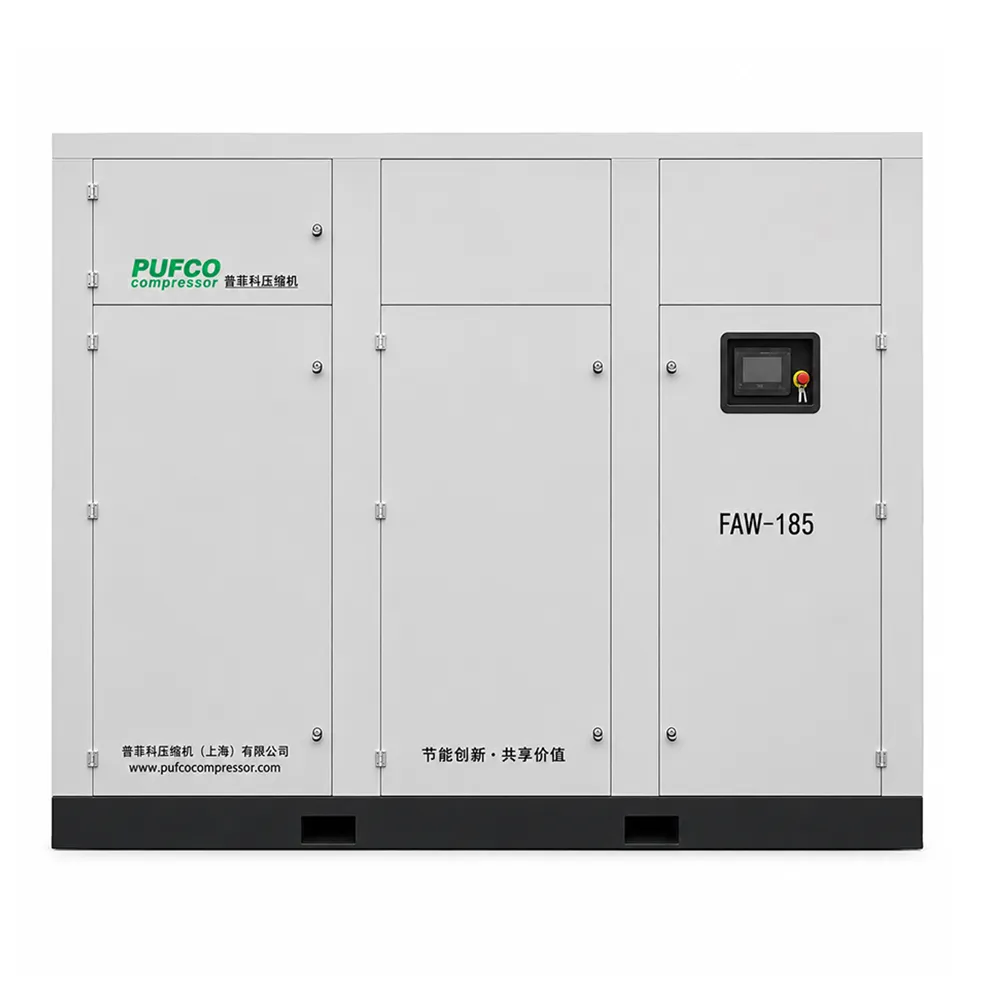
Rotary Screw Oil-Free Compressors: Precision Engineering for Continuous Class 0 Air
Designed specifically for applications requiring guaranteed air purity, rotary screw oil-free compressors eliminate lubricant contact in the compression chamber to achieve ISO 8573-1 Class 0 certification—the most stringent international standard for oil-free compressed air. This is accomplished through precision engineering, specialized material science, and thermodynamic control—not filtration alone.
Teflon-Coated Rotors and Timing Gears Eliminating Lubricant Contact
The core mechanism features intermeshing rotors coated with advanced PTFE-based materials, forming a durable, non-stick barrier that prevents metal-to-metal contact during high-speed rotation. Synchronized by precision-machined timing gears—rather than oil-dependent gear trains—rotor motion remains fully isolated from any lubricant pathway. This design ensures ambient air never encounters oil at any stage of compression, a fundamental requirement validated by independent ISO 8573-1 Class 0 certification testing.
Water Injection Cooling and Its Critical Role in ISO 8573-1 Class 0 Certification
Water injection replaces oil-based cooling to regulate temperature directly within the compression chamber—a key enabler of Class 0 reliability. Unlike oil-lubricated systems, this method delivers three critical advantages:
| Cooling Mechanism Benefit | Technical Contribution |
|---|---|
| Thermodynamic Efficiency | Maintains optimal compression ratios even at rotor speeds exceeding 3,600 RPM |
| Material Stability | Prevents thermal degradation of PTFE coatings by keeping operating temperatures below 180°F |
| Particle Filtration | Water vapor binds with micro-contaminants, enabling their removal via integrated centrifugal separation |
Piston Oil-Free Compressors: Sealed Simplicity for Intermittent High-Purity Demand
Permanently Lubricated Bearings and Self-Lubricating PTFE Components
Piston oil-free compressors isolate the compression chamber entirely from lubricants by using permanently lubricated bearings and self-lubricating PTFE piston rings and cylinder seals. These components are either pre-impregnated or sintered with solid lubricants that migrate gradually over time—ensuring long-term, maintenance-free sliding performance without introducing oil vapor, aerosols, or condensate into the airstream.
Two-Stage Compression and Filtration Integration for Sensitive Applications
For applications requiring both elevated pressure and absolute air purity, two-stage piston designs offer a robust solution. In the first stage, air is compressed to an intermediate pressure, cooled via an intercooler, then fed into a smaller, high-pressure second-stage cylinder. This staged approach reduces thermal stress on critical components, improves volumetric efficiency, and extends service life. When combined with integrated coalescing and activated carbon filtration, this architecture consistently achieves ISO 8573-1 Class 0 compliance—making it ideal for intermittent, mission-critical uses in pharmaceutical manufacturing, food packaging, and laboratory environments where trace oil contamination poses unacceptable risk.
Scroll Oil-Free Compressors: Low-Vibration, Low-Maintenance Class 0 Air for Light Industrial Use
Scroll oil-free compressors generate Class 0 air using two interleaved spiral elements—one fixed, one orbiting—to trap and compress air without any lubricant in the compression path. The absence of valves, pistons, or oil-lubricated contacts makes contamination physically impossible, not just filtered out. Operation is exceptionally quiet (as low as 67 dB(A) at 250 L/min) and vibration-free—comparable to office equipment—enabling direct installation near workstations or in noise-sensitive spaces like dental clinics, research labs, or small-scale food processing lines. With no oil changes, no leaks to monitor, and only two primary moving parts, maintenance demands are minimal. Automatic start/stop cycling further enhances energy efficiency and lowers total cost of ownership—delivering reliable, clean air without system complexity.
Selecting the Right Oil-Free Air Compressor: Matching Technology to Application Requirements
Air Purity, Energy Efficiency, Duty Cycle, and Total Cost of Ownership Compared
Achieving ISO 8573-1 Class 0 air requires selecting a technology aligned with real-world operational needs—not just theoretical purity claims. Rotary screw oil-free compressors deliver unmatched consistency and efficiency for continuous-duty applications, offering the lowest specific energy consumption per cubic meter of air over time—though they carry a higher initial investment. Piston oil-free units provide strong value for intermittent or variable-demand settings, with lower upfront cost but relatively higher energy use per cycle and more frequent component replacement. Scroll compressors strike a balance for light industrial and point-of-use applications: moderate efficiency, near-silent operation, and virtually zero scheduled maintenance. Ultimately, the optimal choice depends on verified flow and pressure requirements, daily runtime patterns, ambient conditions, and long-term ownership priorities—not just compressor type. A rigorous assessment of these factors ensures Class 0 performance without over-engineering capacity or compromising reliability.
FAQ: Understanding Oil-Free Compressors
What does ISO 8573-1 Class 0 certification mean?
ISO 8573-1 Class 0 certification is the strictest standard indicating oil-free air quality. It ensures there’s no detectable oil presence in compressed air, safeguarding sensitive applications like food packaging, pharmaceuticals, and high-precision manufacturing.
What are the key advantages of rotary screw oil-free compressors?
Rotary screw oil-free compressors are ideal for continuous operations. With advanced PTFE-coated rotors and timing gears, they ensure consistent Class 0 air purity and energy efficiency but come with a higher initial investment cost.
Where are scroll oil-free compressors best used?
Scroll oil-free compressors excel in light industrial applications, such as dental clinics and research labs, due to their quiet operation, minimal maintenance, and ability to deliver Class 0 air at low-vibration levels.
How do piston oil-free compressors prevent oil contamination?
By employing permanently lubricated bearings and PTFE components, piston oil-free compressors isolate the compression chamber, preventing oil ingress while delivering durable, high-purity air.
How can I select the right oil-free compressor for my needs?
Choose a compressor based on factors like required air purity, energy efficiency, application-specific duty cycle, and total cost of ownership. Analyze real-world usage patterns to avoid over-engineering or underestimating capacity requirements.
Table of Contents
- Rotary Screw Oil-Free Compressors: Precision Engineering for Continuous Class 0 Air
- Piston Oil-Free Compressors: Sealed Simplicity for Intermittent High-Purity Demand
- Scroll Oil-Free Compressors: Low-Vibration, Low-Maintenance Class 0 Air for Light Industrial Use
-
Selecting the Right Oil-Free Air Compressor: Matching Technology to Application Requirements
- Air Purity, Energy Efficiency, Duty Cycle, and Total Cost of Ownership Compared
- FAQ: Understanding Oil-Free Compressors
- What does ISO 8573-1 Class 0 certification mean?
- What are the key advantages of rotary screw oil-free compressors?
- Where are scroll oil-free compressors best used?
- How do piston oil-free compressors prevent oil contamination?
- How can I select the right oil-free compressor for my needs?

