A centrifugal air compressor raises air pressure by using a rotating impeller to add energy to the airflow, then converting part of that airflow’s velocity into pressure. It is a dynamic compressor: it maintains compression through a continuous flow of air rather than trapping and reducing a fixed volume of air in a cylinder or between screw rotors.
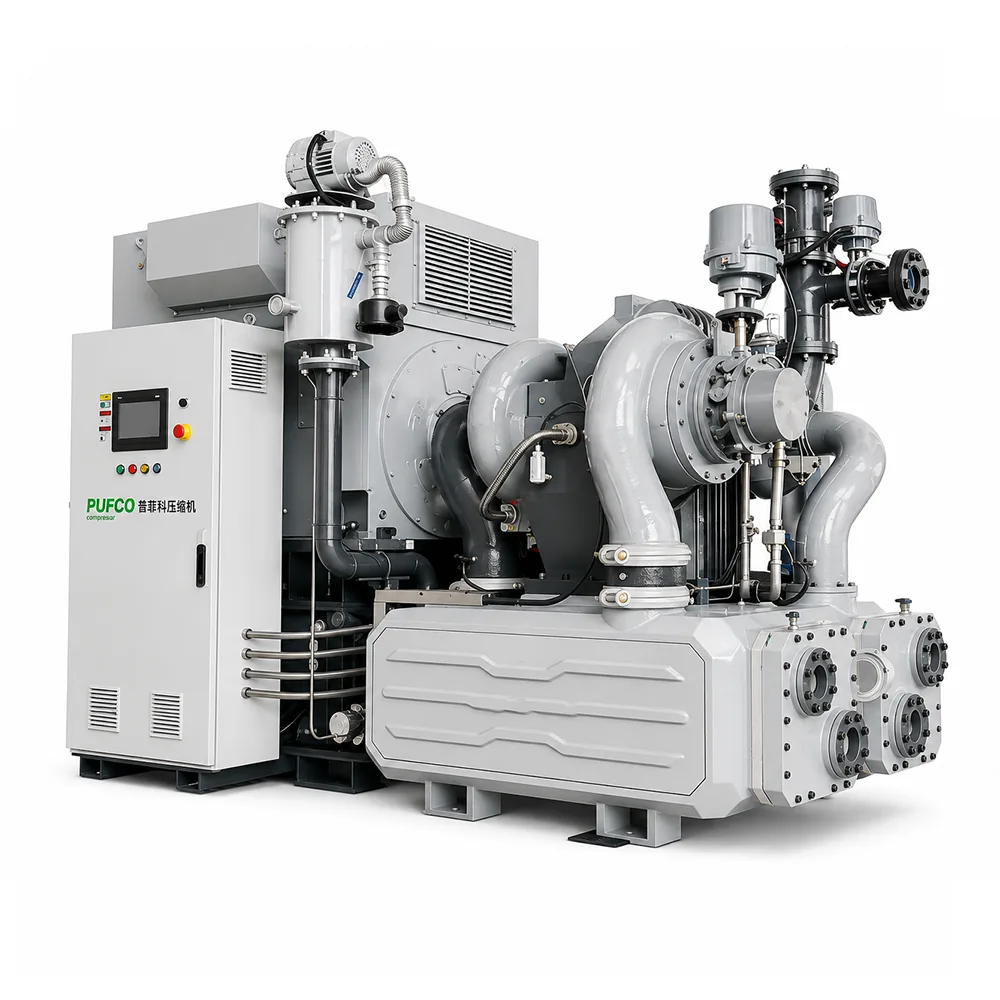
The compression process can be understood in four steps. The exact arrangement depends on the machine, particularly whether it uses one compression stage or several.
Air passes through the intake system and enters near the centre of the rotating impeller. Intake filtration helps protect the flow path from contamination. The condition of that intake system matters because a restriction can affect the air available to the compressor.
The impeller is driven by the machine’s drive system. Its blades transfer mechanical energy to the air as the air moves through the impeller passages.
As the impeller rotates, air moves outward through the blade passages and gains energy. Both velocity and pressure can increase through the impeller. It is therefore an oversimplification to say that the impeller creates only velocity and no pressure.
Impeller and diffuser design are important to the performance of the stage. The compressor must also operate within the flow and pressure conditions for which its aerodynamic components were designed.
Air leaving the impeller passes into the diffuser. The diffuser slows the airflow in a controlled way, converting part of its kinetic energy into static pressure. A collecting passage then directs the air toward the outlet or the next stage.
The result is a continuous stream of compressed air. Unlike a reciprocating compressor’s compression cycle, the process does not rely on a piston repeatedly filling and emptying a cylinder.
In a multistage compressor, air passes through additional compression stages to achieve the required discharge pressure. Cooling between stages can remove heat from the compressed air before it enters the next stage.
The final system may also include aftercooling, condensate separation, compressed-air drying, and filtration. These functions address different parts of air treatment; the compressor alone should not be assumed to deliver every air quality characteristic required by the process.
A screw compressor is a positive-displacement machine. Its intermeshing rotors trap air and reduce the space containing that air as it moves through the compression element. A centrifugal machine instead adds energy to a continuous airflow through rotating aerodynamic components.
This difference affects selection and control. Screw compressors are widely used where air demand varies or where a modular arrangement is useful. Centrifugal machines can be attractive where the operating demand suits their flow range and continuous-duty characteristics.
Neither technology is automatically the more efficient choice for every site. Compare actual performance at the required operating point and across the expected demand profile. Our screw versus centrifugal compressor guide discusses that selection in more detail.
Centrifugal compressors have an operating envelope. If flow falls too far for the pressure conditions, the machine can approach surge, an unstable operating condition involving disturbed or reversing flow.
Controls and protective systems help maintain appropriate operation. The exact control approach and available adjustment range depend on the compressor design and system arrangement. Do not assume that a machine sized for maximum demand will also operate efficiently at a much lower continuous demand.
For selection, provide the supplier with the minimum, normal, and maximum air demand, together with the required pressure. A single maximum-flow figure does not describe the whole operating requirement.
A centrifugal compressor can use a compression path without oil injection. That distinction is useful where the process needs to avoid oil entering the air through the compression chamber.
However, “oil-free compression” does not mean that every part of the machine has no lubricant, nor does it prove the delivered air meets a particular purity class. Intake contaminants, moisture, downstream equipment, and the actual verified configuration still matter. Specify the required air quality and request the relevant documentation for the proposed machine.
Prepare the required airflow and pressure, expected operating hours, demand variation, installation environment, available power, cooling conditions, and air quality requirements. Explain whether the compressor will supply a constant base load or follow changing production demand.
Explore PUFCO centrifugal air compressors or contact our team to discuss the conditions of your project.

We use cookies to keep this site working properly and to understand how it is used. You can accept all cookies or continue with essential ones only. Cookie policy
 CN